BACK

BACK
BACK
BACK
BACK
BACK
BACK
BACK
BACK
BACK
Veganism the Focus of Next Lakeland Lecture
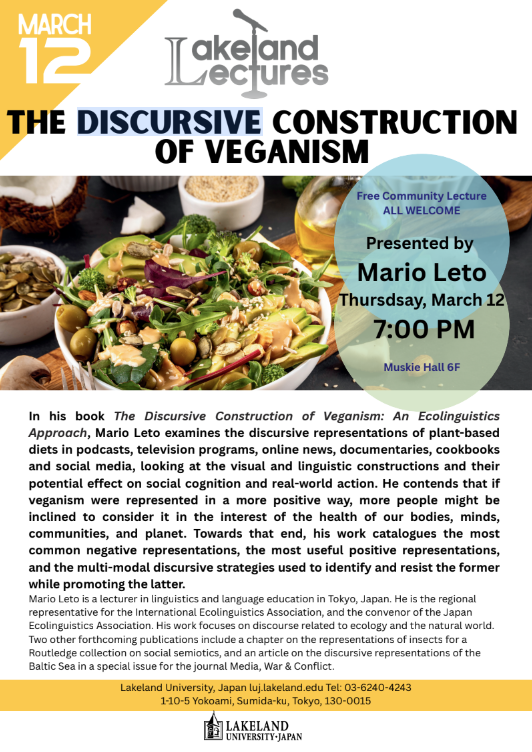
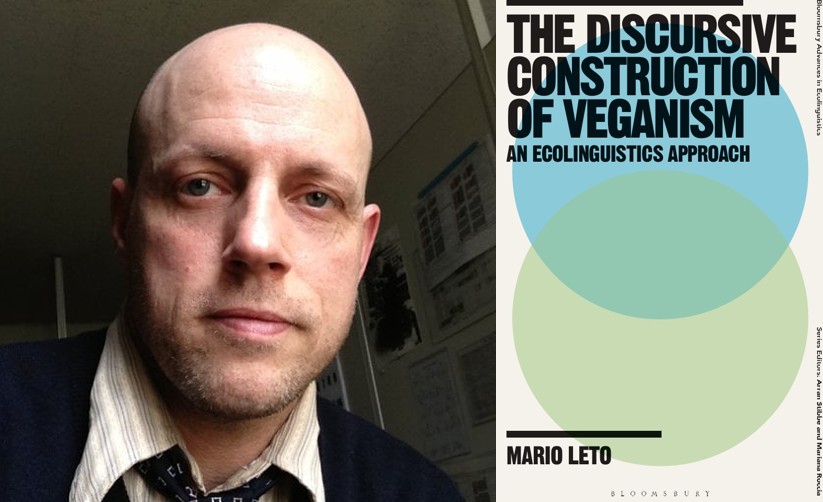
On Thursday, March 12, 7pm, in Muskie Hall (6th floor), our next Lakeland Lecture will be held. This month, Dr. Mario Leto, scholar and professor of ecological linguistics at Meiji University, will be delivering a talk based around the topic of his new book, The Discursive Construction of Veganism: An Ecolinguistics Approach (Bloomsbury UK, 2025).
As always, Lakeland Lectures are free and open to the public. After Dr. Leto's talk, there will be a chance for the audience to ask questions. See the poster below for more details.
We asked Dr. Leto a few questions before his talk on Thursday.
I came to veganism later in life. In fact, I had never met a vegan or a vegetarian until I came to Japan. Back in the day, I worked with a British guy who was vegetarian and we eventually became friends. He undoubtedly had the biggest influence on my decision to change my consumption habits.
I tell the story in the introduction to my book, so I won’t repeat it here, but I will say that being vegan in a country and culture so vastly different than the one I grew up in has helped a lot. In addition to the most salient aspect of veganism, food, veganism also entails considerations of friends and family and the cultural traditions that helped to shape us and build our childhood memories. I don’t have that in Japan, so my journey has perhaps been a bit easier than if I were still living in the suburbs of Chicago.
For anyone considering a change to veganism, I have two suggestions. The first is to do it for the right reasons, which means it should be a deeply ethical choice based in egalitarianism. If that profound change in values does not happen, then staying vegan becomes much more of a challenge. The other piece of advice is to learn to cook. If I had to rely on convenience stores, cafes and restaurants to fulfill my nutritional needs, then being vegan would be much more difficult to sustain.
When I claim that veganism is often represented negatively in discourse, that claim is less of an implication and more of an objective reality revealed through my research. There are of course positive representations of veganism as well, but there are a few fundamental differences between the positive and the negative which highlight the proliferation of negative worldviews.
One difference is the kind of discourse in which those representations are found. In my study, negative representations were found in prolific, widespread media, like news media and user comments. Positive representations, on the other hand, were found in less widely consumed discourse, like that in vegan cookbooks, vegan documentaries, and vegan social media accounts.
Another difference concerns how negative representations are interrelated and synergistic, meaning that they tend to cluster and are more powerful because of it. The representation of veganism as unhealthy tends to trigger the representation of vegans as mentally unstable (considering both mental and physical health), and those tend to trigger the representation of vegans as ignorant or insincere (considering how much vegans tell everyone how healthy vegan food is).
The final difference is that positive representations seem to have been introduced specifically to counter and resist the negative representations, meaning that the negative representations are foundational, which gives them precedence.
In my study, the representation of veganism as unhealthy was the most prolific negative representation, and the groundbreaking documentary film The Game Changers focused almost solely on the health benefits of veganism, attempting to counter and resist the idea that veganism is unhealthy.
Simply put, negative representations of veganism are widespread, prolific, synergistic, and foundational, all qualities which help to spread and maintain negative worldviews about plant-based diets. With vegans making up only one to two percent of the world’s population, these results and their effect on social cognition make sense.
These things are complicated, so I’ll start by saying that nobody in this modern world can be the perfect vegan who avoids all animal products. From vehicle tires and plastic bags to asphalt and toiletries, animal products are ubiquitous and nearly impossible to avoid. I describe myself as an “aspirational” vegan, meaning that I do the best that I can to inflict the least amount of harm and cruelty on the rest of the world. Some people call this “flexitarianism,” but that name is vague and scarred and invites claims of hypocrisy.
Personally, I try to avoid all animal foods, including meat, fish, poultry, dairy, and eggs, and those hidden food products like gelatin and isinglass. I also try to avoid leather, down, and any other animal-derived product used for clothing and such. Have I ever eaten meat since I became vegan? Not knowingly or on purpose.
Have I swung into vegetarianism (consuming dairy) when in high stakes social situations, aiming for deeper social connections with larger, more beneficial pay-offs in the future? Yes, I have. And some staunch vegans would take me to task for that, but I personally don’t see that kind of attitude based in any reality with any less cruel future for the animals or for anyone else who has been marginalized because of our current consumption habits and our insatiable desire for extreme wealth.
So the answer to the question is this: There is no “truly following a plant-based diet”. There is only doing the best we can do in the circumstances that we are in to reduce the amount of cruelty and suffering in this world.
Follow LUJ on Instagram